Generation Genius Science Review: Lessons, Grades, Curriculum and Value
Science can be hard to teach when children find textbooks dull or parents have little time to plan experiments. Teachers also need lessons that explain complex ideas without losing students’ attention. Attracts families and educators because it combines videos with lesson plans, activities, worksheets, vocabulary, reading material, quizzes, and assessments.
When evaluating a science learning platform, the first things I look at are scientific accuracy, grade-level depth, hands-on work, assessment, and the amount of adult preparation required. I also check whether the platform is a complete curriculum or a supplement.
This Generation Genius Science review explains what the program includes, how it may help parents and teachers, where it has limits, and whether it is worth considering for K 8 science.
Is Generation Genius Science worth it?
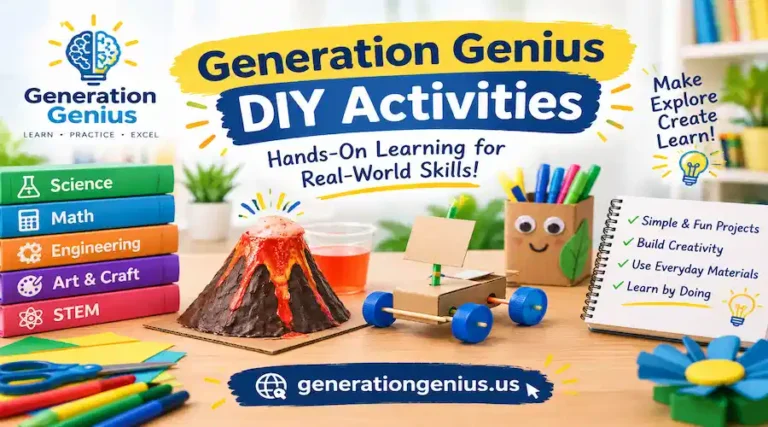
Generation Genius Science is an online K 8 science resource with video lessons and supporting materials. The official platform lists lesson plans, vocabulary, printable worksheets, reading material, Generation genius DIY activities, quiz games, teacher guides, and assessments.
It may be worth considering for teachers, homeschool families, and parents who want engaging science introductions with low-preparation activities. However, the company’s help page describes it as supplemental material, not a replacement for a textbook. Families that need a complete science curriculum should add or compare other resources.
What Does Generation Genius Science Include?
Generation Genius Science is built around video based lessons. Each topic is grouped by grade band and supported by additional resources. The exact materials may vary by lesson and subscription plan, so check the individual lesson page before buying.
Video lessons
The videos cover major K 8 science topics. Examples include:
The official website lists separate collections for K to 2, grades 3 to 5, and grades 6 to 8.
Lesson plans
Lesson plans can help an adult prepare a science session. They may include discussion prompts, learning goals, materials, and activity instructions.
A lesson plan can save time, but it does not remove the need for teaching judgment. The adult still needs to decide when to pause, explain a new term, or connect the topic to the child’s experience.
Investigations and DIY activities
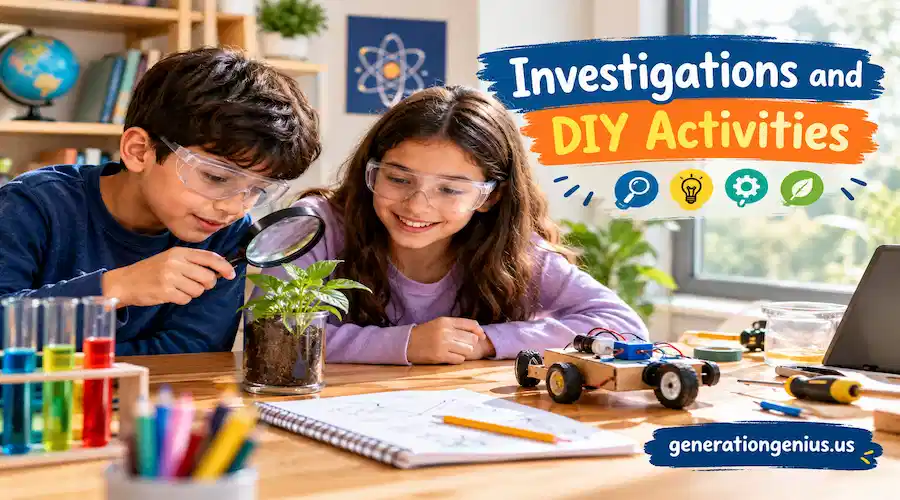
The platform includes science investigations and simple do it yourself activities. These can make an abstract idea more concrete.
Families should check the materials list before starting. A low-preparation lesson may still require items such as cups, water, paper, speakers, magnets, food coloring, or household objects.
Vocabulary and reading
Science vocabulary can be difficult for young learners. Vocabulary lists and reading material may help children connect a new term with the concept shown in the video.
For stronger learning, ask the child to:
Worksheets and quizzes
Worksheets and quizzes provide written practice and quick checks. The official help page says subscribers can access an generation genius answer key for K 8 paper quizzes and practice problems.
These tools are useful, but a quiz does not always show deep understanding. Ask children to explain their evidence, create a model, or apply the idea to a new problem.
Science Grades and Topics
Generation Genius Science organizes content into three main age groups:
The topic library covers life science, physical science, earth and space science, environmental science, and engineering.
|
Grade band |
Example science topics |
Likely use |
|
K to 2 |
Senses, plants, habitats, weather, sound, pushes and pulls, materials, and living things |
Introduction and guided exploration |
|
3 to 5 |
Forces, ecosystems, fossils, matter, energy, the water cycle, moon phases, body systems, and weather |
Core concept teaching and review |
|
6 to 8 |
Cells, genes, natural selection, chemical reactions, Newton’s laws, electricity, climate, earth history, and engineering |
Foundation, review, or supplementary instruction |
The official site lists many state-specific standards percentages. For example, it displays different percentages for states such as Florida, Texas, California, and New York. These are publisher claims, so check the state specific alignment page before using them to plan a complete course.
How Does a Generation Genius Science Lesson Work?
A typical lesson may include these steps:
Common Sense Education reports that the lessons use elements of the 5E model and encourage students to engage with questions, investigations, and explanations.
The teacher or parent still has an important role. Common Sense also notes that some lessons offer limited opportunities for students to create their own questions or design investigations. You can improve the lesson by asking open ended questions and changing the activity so children test their own ideas.
Is Generation Genius Science a Full Curriculum?
No. The official help page describes Generation Genius as supplemental material. It says the platform aims to increase engagement and help students learn core concepts, rather than replace a textbook.
This does not mean the platform is weak. It means you should understand its role.
A complete science curriculum may include:
Generation Genius includes many valuable lesson components, but families should verify how well those components meet their full-year needs.
The platform may work as a primary resource for some younger learners when an adult adds planning, reading, writing, and assessment. It is safer to view it as a supplement, especially for grades 5 to 8, unless your full learning plan supplies the missing structure.
Generation Genius Science Review for Homeschool
Generation Genius may suit homeschool families who want secular, video-led science with activities and teacher support.
It can help parents:
A simple weekly routine could look like this:
This routine is only a starting point. Older students may need more writing, research, lab work, and independent reading.
Parents should also prepare the materials listed in the lesson plan. Cathy Duffy’s review notes that activities can often be adapted for homeschool, but planning ahead is important.
Generation Genius Science for Teachers
Teachers can use the platform to:
The official help page says school plans can generate one-click student links. Students can open a shared lesson without creating their own accounts. Student links are available for school plans.
Common Sense Education recommends using the lesson materials instead of showing the videos alone. It explains that investigations, discussion, and assessment help students engage more actively with the science content.
Is It Good for Different Learners?
Reluctant learners
The lively video format may attract children who do not enjoy traditional science reading. The engaging style can help introduce a topic.
However, entertainment does not guarantee retention. Follow the video with questions, notes, and an activity.
Struggling learners
The platform may help a child who needs another explanation or a visual example. Vocabulary support and repeated review can also help.
It may not be enough for a child with major learning gaps. Such students may need simplified text, one-to-one support, repeated practice, or specialist instruction.
Advanced learners
Grades 6 to 8 include topics such as cells, genes, natural selection, chemical reactions, electricity, and Newton’s laws.
Advanced students may still need:
Independent learners
The videos are easy to start, but independent learning depends on the child’s reading ability, attention, and confidence. Younger children usually need adult guidance.
Do not assume that a ready made video course is fully self teaching.
Standards and NGSS Alignment
Generation Genius states that its science content aligns with the Next Generation Science Standards and provides state-by-state alignment information.
The help page explains that the National Science Teaching Association helps select topics, review scripts for clarity and accuracy, and approve videos before release.
These are useful trust signals. Still, standards alignment should not be confused with complete curriculum coverage. A standards map tells you whether topics connect to expectations. It does not tell you how much practice, writing, review, or assessment a child receives.
Pros and Cons
|
Pros |
Cons |
|
Broad K 8 science topic coverage |
Officially described as supplemental |
|
Video lessons may engage reluctant learners |
Requires online access |
|
Includes lesson plans and teacher guides |
Some activities need adult preparation |
|
Offers vocabulary and reading support |
Some lessons may limit student-led inquiry |
|
Includes worksheets, quizzes, and activities |
Older students may need deeper material |
|
Can support school and homeschool use |
Subscription cost may feel high for some families |
|
Spanish subtitles are available for K 8 science videos |
Screen time may concern some parents |
The Common Sense Education review praises the lesson materials but says some activities could give students more control over questions and investigations. Homeschool reviews also suggest that the platform may feel stronger for younger and elementary learners than for older students seeking rigorous depth.
Pricing, Free Trial and Refunds
Pricing changes over time and may vary by plan. The official pricing page currently presents options for schools, districts, individual teachers, and homeschool families. It lists science, math, and ELA access depending on the selected plan.
The same page currently lists:
The official help page says annual subscriptions last 12 months and that new subscriptions receive a 30-day money-back guarantee.
Before publishing a price, verify:
Do not copy the older $95 price found in the Cathy Duffy review. That page was last edited in 2021 and clearly warns that prices can change.
What Are the Main Limitations?
Designed to replace a textbook
The official help page calls the platform supplemental. Use it with a full plan if you need structured progression and cumulative review.
Requires internet access
The help page says the videos stream through modern web browsers on computers, tablets, and phones. No software installation is required.
Confirm offline access before buying if your family has limited internet.
Investigations need preparation
Simple activities require materials, supervision, and time. Read the lesson plan before scheduling the activity.
Student led inquiry
Common Sense Education notes that some lessons direct students toward a correct answer rather than allowing them to design a completely open investigation. Teachers can add their own questions and variations.
Student need Depth
The 6 to 8 library can support foundation and review. Older learners may need more advanced reading, laboratory work, data analysis, and scientific writing.
Screen time requires balance
Use the videos as one part of the lesson. Add conversation, observation, writing, building, measuring, and outdoor work.
Who Should Use Generation Genius?
It may be a good fit for:
Who May Not Benefit?
It may be a weaker fit for:
Generation Genius Science Alternatives
Choose an alternative based on the problem you want to solve.
|
Your goal |
Look for |
|
Complete homeschool science |
Scope, sequence, reading, experiments, assessments, and review |
|
Low prep classroom teaching |
Videos, teacher guides, investigations, and student access |
|
Hands-on science |
Experiment kits, lab materials, safety guidance, and data collection |
|
Literature-based science |
Books, narration, research, and writing |
|
Advanced science |
Deeper content, formal lab work, and scientific analysis |
|
Free science enrichment |
Public videos, library resources, and free activities |
|
Reduced screen time |
Print-based lessons, nature study, and physical experiments |
Potential comparison topics include:
Make sure every comparison uses current prices and matching grade levels.
FAQs
What is Generation Genius Science?
Generation Genius Science is an online K 8 science resource with videos, lesson plans, activities, worksheets, vocabulary, quizzes, and assessments.
Is Generation Genius Science a full curriculum?
No. The official help page describes it as supplemental material rather than a textbook replacement.
What grades does Generation Genius Science cover?
It organizes science content into K 2, grades 3 to 5, and grades 6 to 8.
Does it include experiments?
It includes DIY activities and science investigations. The materials and preparation requirements may vary by lesson.
Can homeschool families use Generation Genius Science?
Yes. The official help page says homeschool families can purchase a homeschool plan and receive the same resources as teachers.
Does it work for classroom teaching?
Yes. Teachers can use videos, lesson plans, investigations, worksheets, quizzes, and school student links.commonsense+1
Does it align with NGSS?
The publisher states that its science content aligns with the Next Generation Science Standards. The National Science Teaching Association helps review and approve the content, according to the official help page.
Does it have Spanish subtitles?
The official help page says all K 8 science videos have Spanish subtitles.
Does it work offline?
The official help page describes browser-based streaming. Verify offline availability before subscribing.
Is Generation Genius Science worth it?
It may be worth it for teachers and families who want engaging videos with supporting materials. It may be less suitable for users seeking a complete, lab-heavy, fully structured science curriculum.
Is it suitable for middle school?
It includes grades 6 8 science topics. However, older students may need extra reading, writing, lab work, and deeper investigations.
Final verdict
Generation Genius Science is a strong option for engaging K 8 science introductions, classroom support, review, and homeschool enrichment. Its official resources include videos, lesson plans, vocabulary, worksheets, reading material, DIY activities, quizzes, and assessments. The program also provides standards-alignment information and Spanish subtitles for its K 8 science videos.generationgenius+1
The main limitation is clear Generation Genius itself describes the platform as supplemental, not a replacement for a textbook. That makes it a better fit for families and teachers who want a lively science resource to strengthen an existing plan.
Based on the available evidence, I would assess it most favorably for K 5 engagement and support, while checking depth and structure carefully for grades 6 to 8. Before subscribing, test a few lessons, review the current plan, and compare the resources with the learning outcomes your child must meet.
If you’re looking for a fun and engaging way to make science easier for kids, explore Generation Genius for interactive lessons, experiments, and educational resources.
3 Comments