Generation Genius Math Review: Lessons, Grades, Curriculum and Value
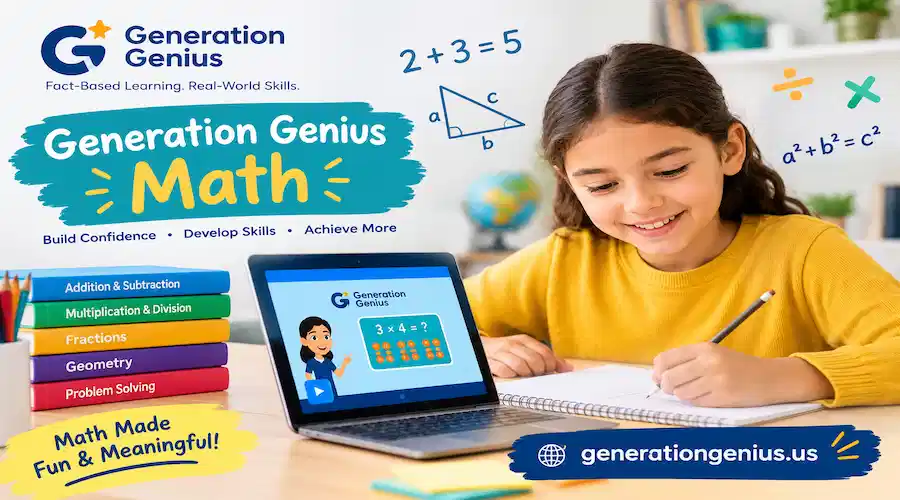
Parents and teachers often want math lessons that hold a child’s attention. They may also need simple explanations, ready to use practice, and less planning time. Genius Math may look appealing because it combines videos with reading material, quiz games, activities, worksheets, and lesson resources. However, many families still ask an important question: is it a complete math curriculum or only a learning supplement?
When evaluating a math learning platform, the first things I look at are its grade coverage, topic depth, practice options, assessment tools, and ease of use. I also look at what the platform does not provide.
In this Generation Genius Math review, you will learn how the lessons work, what grades and topics are covered, how it may help parents and teachers, and whether it offers enough structure for your learning plan.
Quick answer
Generation Genius Math is a K 8 digital math resource with videos, reading material, quiz games, activities, worksheets, and lesson support materials. The official website lists topics from early number skills to algebra, probability, statistics, geometry, and other middle school concepts.
It may work well as a teaching supplement, review tool, or enrichment resource. It should not automatically be treated as a complete math curriculum without checking its scope, practice depth, assessment system, and fit with your state or homeschool plan.
What Does Generation Genius Math Include?
Generation Genius Math is built around short digital lessons and supporting resources. The official math page promotes:
The exact resources can vary by lesson and subscription plan. Check the individual lesson page before promising that every topic includes the same materials.
Math videos
The video format can help introduce a new idea. For example, a child may watch a lesson about place value, fractions, angles, ratios, or algebraic expressions. A teacher or parent can then discuss the idea and assign practice.
A video is useful for explanation, but watching alone does not prove mastery. Children usually need guided practice, feedback, correction, and review.
Worksheets and practice
The official grade pages list resources such as printable worksheets, reading material, practice word problems, and lesson plans. The fourth grade page, for example, includes topics such as symmetry, area, angles, rounding, measurement, and standard algorithms.
These resources may help reinforce a lesson. However, parents should check whether the amount of practice is enough for their child’s needs.
Quiz games and assessments
Quiz games can provide a quick knowledge check. They may be useful after a video or activity. Still, a short quiz is not the same as a full assessment system.
If you need detailed progress tracking, cumulative tests, placement tests, or formal grading, verify whether your selected plan includes those features.
Math Grades and Topics
Generation Genius organizes its math content into K 2, 3 to 5, and 6 to 8 groups. The official topic list includes early number concepts, operations, measurement, geometry, fractions, decimals, algebra, probability, statistics, and functions.
|
Grade group |
Example topics |
|
K 2 |
Counting, number lines, shapes, addition, subtraction, place value, time, measurement, and simple data |
|
3 to 5 |
Fractions, decimals, multiplication, division, area, volume, rounding, angles, coordinate planes, and patterns |
|
6 to 8 |
Negative numbers, ratios, proportions, equations, inequalities, functions, probability, statistics, exponents, and geometry |
The official site states that it covers 96% of K 8 Common Core Math topics. It also lists separate state level percentages, which vary by state. Treat these as the publisher’s standards alignment claims and check your state’s detailed alignment before relying on them.
Examples of topic coverage
The official pages list topics such as:
This range suggests broad topic coverage. It does not, by itself, prove that the platform provides a full year long course for every grade.
How Does a Lesson Work?
A practical Generation Genius Math lesson may follow this sequence:
The best results usually come from treating the video as the beginning of the lesson, not the entire lesson. A parent may need to add manipulatives, notebook work, extra problems, or one to one help.
Is Generation Genius Math a Full Curriculum?
The safest answer is not by default.
Generation Genius provides many curriculum support materials, and its math library covers a broad range of K 8 topics. However, a full curriculum usually includes more than videos and individual lessons. It may also include:
The official platform describes its resources as standards aligned and includes lessons, worksheets, quizzes, activities, and teaching materials. That makes it useful as a supplement or lesson resource. You should verify the current plan before calling it a complete replacement for a structured math program.
For many families, the most realistic setup is to use Generation Genius Math alongside a main curriculum, textbook, workbook, tutoring plan, or teacher created schedule.
Generation Genius Math for Home school
Generation Genius Math may help homeschool parents who want:
A simple homeschool routine could look like this:
This routine is only a framework. The parent should adjust it based on the child’s age, confidence, and progress.
Homeschool parents should also check whether the plan includes enough independent practice, answer support, assessments, and record keeping tools. If it does not, add those elements from another resource.
Generation Genius Math for Teachers
Teachers may use the platform to:
The official pages promote lesson plans, worksheets, quizzes, and teacher materials. The platform also offers grade specific topic pages that can help teachers find a lesson quickly.
Before using it as a central teaching resource, compare its topic sequence with your district curriculum. A platform can align with many standards while still requiring the teacher to decide when and how each lesson fits.
Is It Good for Struggling Learners?
It may help a struggling learner when the child needs:
However, a video cannot diagnose the reason a child is struggling. The problem may involve number sense, language, memory, attention, gaps from earlier grades, or anxiety.
Use the lesson with direct support. Ask the child to explain the idea, solve a new problem, and show the steps. If errors continue, use simpler materials or seek help from a teacher or tutor.
Is It Good for Advanced Learners?
Generation Genius Math may provide useful topic exposure and review. The official topic list includes middle school concepts such as functions, systems of equations, probability, and transformations.
Advanced learners may still need:
Do not assume that broad topic coverage always means advanced depth.
Pros and Cons
|
Pros |
Cons |
|
Covers a broad range of K 8 math topics |
May not replace a complete curriculum |
|
Includes videos and supporting materials |
Some children may need more practice |
|
Offers grade group organization |
Internet access may be required |
|
Can save teacher preparation time |
Screen time may concern some families |
|
Includes worksheets and quiz style resources |
Progress tracking may need verification |
|
Useful for review and enrichment |
Pricing and plan details can change |
|
Supports classroom and homeschool use |
Topic coverage does not guarantee mastery |
Pricing and Value
Generation Genius pricing can change by audience, region, plan, and promotion. The official pricing page currently separates options for schools and districts, individual teachers, and homeschool families. It lists access to science, math, and ELA resources depending on the selected plan.
Do not rely on older review pages for current prices. One independent review lists $175 per year and an older free trial offer, but that information may no longer reflect the current offer.
Before subscribing, check:
The official pricing page also displays a 30 day money back guarantee, but verifies the current terms before purchase.
Main Limitations
Not Complete Course
The broad lesson library is useful, but a full math course needs sequence, mastery checks, review, and progress planning.
Depends on online access
The platform is delivered online. Families with slow or unreliable internet should test the service before subscribing and verify whether offline access is available.
Increase screen time
Parents should balance videos with writing, manipulatives, discussion, and offline problem solving.
More practice may be needed
A child who needs repeated practice may require additional worksheets, a workbook, tutoring, or teacher created exercises.
Plan details may differ
Features, subjects, pricing, and access can vary by plan. Verify the selected plan instead of assuming that every page or review describes the same subscription.
Who Should Use Generation Genius Math?
It may be a good fit for:
Who May Not Benefit?
It may be a weaker fit for:
Generation Genius Math Alternatives
Choose alternatives based on your goal rather than popularity.
|
Your goal |
What to look for |
|
Complete homeschool math |
Scope and sequence, placement tests, practice, review, and grading |
|
Math enrichment |
Games, puzzles, investigations, and open ended problems |
|
Struggling learner support |
Remediation, feedback, repetition, and teacher support |
|
Classroom review |
Short lessons, printable practice, quizzes, and sharing tools |
|
Independent learning |
Clear instructions, feedback, progress tracking, and help |
|
Advanced learning |
Challenging problems, deeper concepts, and flexible pacing |
Compare any alternative using:
FAQs
What is Generation Genius Math?
Generation Genius Math is an online K 8 math resource that combines videos with reading material, quiz games, activities, worksheets, and lesson support resources.
What grades does Generation Genius Math cover?
The official site organizes math content into K 2, 3 to 5, and 6 to 8 groups.
Does Generation Genius Math include worksheets?
Official grade pages list printable worksheets for many topics. The exact resources may vary by lesson and plan.
Is Generation Genius Math a complete curriculum?
It offers broad content and supporting resources, but parents should verify scope, sequence, assessment, practice, and progress tracking before treating it as a complete curriculum.
Can homeschool families use Generation Genius Math?
Yes, homeschool families may use it as a lesson resource, supplement, or enrichment tool. Check the current homeschool plan and included features before subscribing.
Is Generation Genius Math good for teachers?
It may help teachers introduce, review, or reinforce math concepts. Its usefulness depends on how well the available lessons match the classroom curriculum.
Does it cover Common Core Math?
The official website states that it covers 96% of K 8 Common Core Math topics. This is a publisher claim, so check the detailed standards page and your state requirements.
Is Generation Genius Math worth it?
It may be worth considering if you value video lessons and ready made supporting resources. It may be less suitable if you need a complete course with detailed mastery tracking and extensive practice.
Does Generation Genius Math work offline?
The service is designed as an online platform. Confirm current offline access options before purchasing.
Can it help a child who struggles with math?
It may offer another explanation and useful review. However, it cannot replace diagnosis, targeted intervention, or one to one support when a child has major learning gaps.
Final verdict
Generation Genius Math appears most useful as a K 8 math supplement, review tool, and lesson support platform. Its official pages show a broad topic library with videos, reading material, quiz games, worksheets, activities, and lesson resources. These features may help teachers and parents make math lessons more engaging.
Based on the available information, I would not describe it as a complete stand alone math curriculum without checking the exact plan and scope for a child’s grade. A careful evaluation should compare its topic sequence, practice depth, assessments, and progress tools with the rest of your math program.
If you already have a structured curriculum, Generation Genius Math may add useful explanations and variety. If you need one complete system, look for the missing planning and mastery features before deciding.
If you’re looking for a fun and engaging way to make science easier for kids, explore Generation Genius for interactive lessons, experiments, and educational resources.
2 Comments